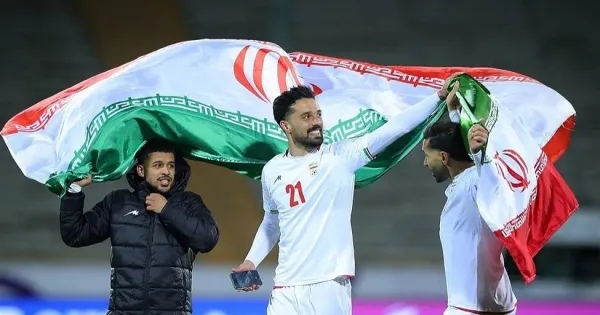
President Donald Trump said he did not think it would be “appropriate” for the Iranian soccer team to attend this year’s World Cup, co-hosted by the United States and cited safety concerns as a reason. Photo credit: iranwire.com
As the 2026 World Cup unfolded across the United States, Canada, and Mexico, the Trump administration’s handling of Iran’s national soccer team drew sharp criticism from sports officials, civil‑rights advocates, and international observers. While Iran was not formally barred from the tournament, a series of restrictive measures — from visa denials to public discouragement — created what many described as an atmosphere of exclusion.
Restrictive Policies and Public Signals
Iran’s players and essential staff ultimately received permission to enter the United States. However, several senior Iranian football officials were denied visas, a move Iranian authorities said undermined their ability to participate fully in the tournament’s administrative and logistical requirements.
President Trump publicly questioned whether Iran’s presence at a World Cup hosted partly on U.S. soil was “appropriate,” comments that Iranian officials interpreted as an attempt to delegitimize their participation. In football circles, speculation even emerged about replacing Iran with Italy — a suggestion that further heightened tensions.
The team’s travel permissions were also unusually narrow. Iranian players were initially allowed to enter the U.S. only shortly before their matches and were required to depart immediately afterward, a level of restriction not applied to other national teams.
Markwayne Mullin, United States Secretary of Homeland Security chief, celebrated the visa withdrawals in remarks reported by The Guardian, saying he “might’ve sung a song or even danced a happy dance” when Iranian officials were told to leave U.S. soil.
The scrutiny extended beyond Iran. Somali referee Omar Abdulkadir Artan — named CAF’s Best Male Referee of 2025 — was detained for 17 hours at Miami International Airport before being denied entry and sent back to Turkey. According to ESPN, U.S. officials provided no legitimate cause for the interrogation.
Iran’s Response
Iran’s national team expressed concern throughout the tournament about what it viewed as unequal treatment. The team’s head coach filed a formal complaint with FIFA, alleging discriminatory practices and violations of the organization’s standards for host‑nation conduct.
A Broader Pattern of Host‑Nation Behavior
For many international observers, the controversy fit into a broader pattern of confrontational foreign‑policy decisions by the Trump administration. Critics pointed to past actions — including aggressive rhetoric toward foreign governments and military operations abroad — as evidence of a worldview that fosters hostility rather than sportsmanship.
The administration’s approach to the World Cup, they argued, sent a troubling message to visiting nations and fans. Millions of spectators traveled to North America for the tournament, contributing significantly to local economies. Yet some left feeling misled by U.S. officials and media narratives that had promised a welcoming environment.
The Stakes for Global Sport
The World Cup is designed to be a rare moment of unity — a tournament where geopolitical tensions are set aside in favor of competition and cultural exchange. By imposing restrictive policies on Iran’s delegation, critics say the U.S. undermined that spirit and risked setting a precedent for future host nations.
https://www.facebook.com/share/r/1D9uKpvFq4/
The Iranian team, they emphasize, is not the enemy of the United States. It is a group of athletes representing their country on the world stage. The tournament is called the World Cup, not Trump Cup or a platform for political score‑settling.
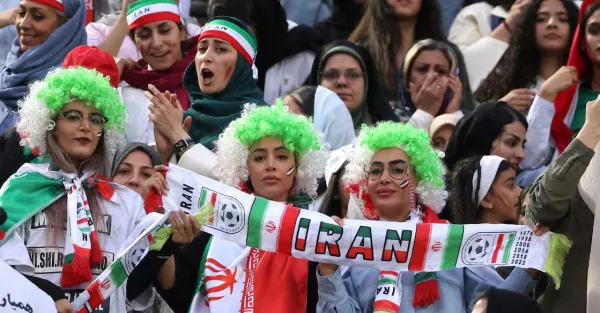
Caption for additional image: Iran's fans at the world cup 2026. Canada and Mexico, the co-host nations alongside the US, do not have travel restrictions against Iran.
Photo credit: onmanorma.com
Mahmoud El‑Yousseph is a Palestinian freelance writer and retired U.S. Air Force veteran. He writes on U.S. foreign policy, Middle East affairs, and justice. Email: elyousseph6@yahoo.com